
Scheduled economic news — inflation prints, jobs reports, rate decisions, oil inventories — moves futures markets violently. Every trading course says so, and it’s true. We wanted the question nobody answers with a complete sample: which of these moves can you actually get paid for, after real costs?
So we tested all of it. Not the promising ones — all of it.
The sweep #
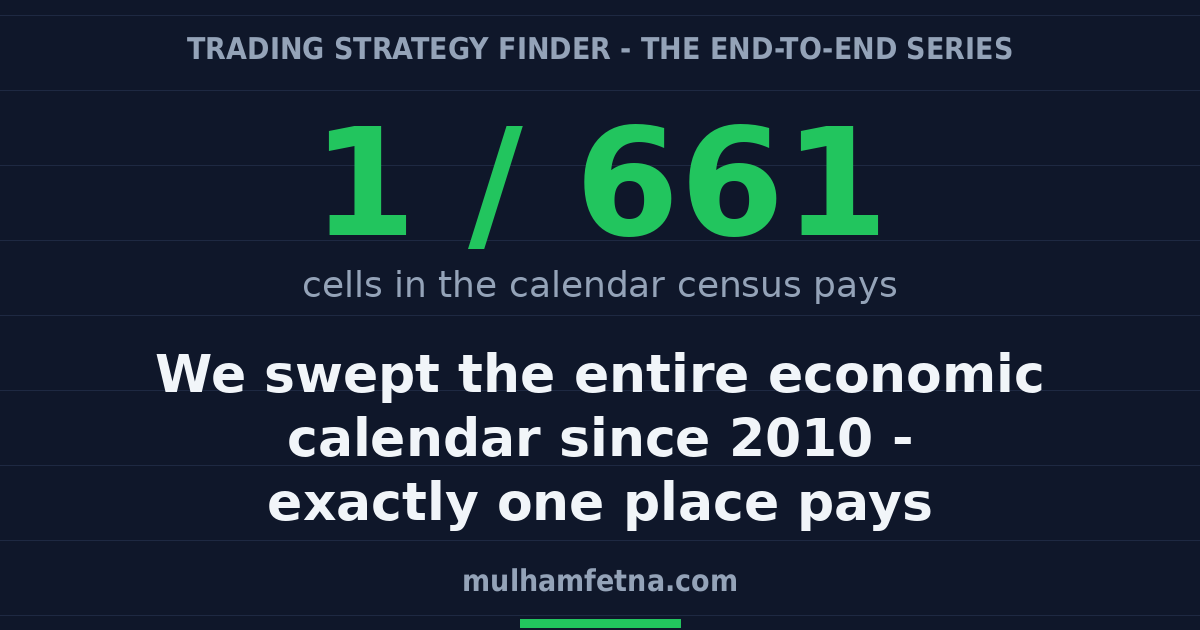
Three waves, each pre-registered before running: first 612 market×news pairs on nine futures markets against the full calendar since 2010; then the secondary series (11,822 additional news moments); finally a literal closure census of all 661 remaining series×instrument cells, so that every combination in our registry has a recorded verdict — positive, negative-with-power, or honestly “underpowered, no verdict”. Costs stressed on every table.
The answer: one place #
The US CPI (inflation) release, on equity-index futures. That’s it. The market jumps on many things; it pays on this one:
- Long NQ (Nasdaq futures), entering 300 seconds before the release, fixed stop and target: +$133 per event net of stressed costs, t = 4.13 — and it survives a Bonferroni correction across all 54 cells of that study design.
- ES (S&P futures) riding CPI alone: 116 events, +$151.37 per event at $52.50 of stressed costs, p = 0.0027, the release jump 20.5× the quiet baseline, both sample halves positive, control floor and a 1,000-placebo noise check green. Recent regime (2024–2026): +$529 per event.
- The premium is ordered exactly by index sensitivity: Nasdaq > S&P > Dow > Russell. It is an equity-index phenomenon — the same event on gold or oil pays nothing.
flowchart LR
    NQ["NQ · Nasdaq
most index-sensitive
largest premium"] --> ES["ES · S&P 500"]
    ES --> YM["YM · Dow"]
    YM --> RTY["RTY · Russell
smallest premium"]
    RTY -.-> X["GC · CL · NG …
same event,
pays nothing"]
The graveyard (equally important) #
Of the 661-cell closing census, exactly one cell came out exploratory-positive. 179 cells are significant negatives — and here’s the instructive part: 41% of those lose purely to costs (their gross edge is within $5 of zero), and 29% are actually gross-positive before friction. The market really does move; the move really is bigger than quiet times; and the spread eats it. Violence is not premium.
Two named tombstones worth remembering:
- Retail Sales is an anti-premium. Trading its jump loses money gross — not net, gross — on seven of nine instruments, in both directions. It replicated across two independent study waves. Whatever moves price at 08:30 on Retail Sales day, you are on the wrong side of it by construction.
- Natural gas’s own inventory report jumps 8.5× baseline and grosses −$4.89 per event. The most market-specific news there is, and it pays nothing even before costs.
Why you can trust these verdicts #
Every claim above is a machine-verified entry in our public claims ledger — the number re-derives from committed evidence files on every CI run, each with a falsification test and a declared blind spot (the CPI results, for instance, declare their era-concentration openly: the magnitude lives in the recent regime). Negatives were only allowed when the test had the power to see a cost-sized effect. The repo: github.com/mulhamfetna/trading-strategy-finder.
The broader story of the project — including the famous strategy that failed all 225 of its pre-registered configurations — starts here: the end-to-end overview.
BeInMedia (Nmo AI), Kuwait • Dubai • Doha.