
This is the story of a research project my team at BeInMedia ran from May to September 2026: a systematic attempt to find out what actually survives in futures trading once you stop fooling yourself. We built the machinery, paid for the answers, and published everything — including the failures. The code, the evidence, and every number below are public and machine-verifiable: github.com/mulhamfetna/trading-strategy-finder.
Here is the whole arc, honestly told.
flowchart LR
    A["May 2026
machinery built:
backtest engine · optimizer ·
claims ledger"] --> B["Jun–Aug 2026
the studies:
economic-calendar sweep ·
225-cell ORB grid ·
forward test of our own fleet"]
    B --> C["Aug 31, 2026
track record frozen
under a signed protocol"]
    C --> D["Sep 2026
two preprints filed ·
everything published,
including the failures"]
The rule that shaped everything #
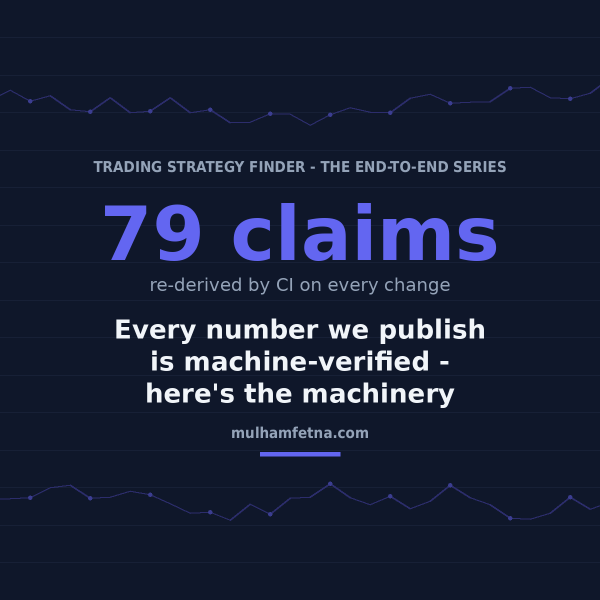
Backtests lie — not because the math is wrong, but because the person running them chooses what to try, what costs to assume, and what to show you. Our defense was structural: every study was pre-registered before it ran (design, thresholds, controls frozen in writing first), every negative result had to prove it had the statistical power to see an effect, every positive had to beat a dumb control, and every published number lives in a machine-verified claims ledger — re-derived from committed evidence files by our CI on every change, 79 claims and counting. If a number in this series doesn’t re-derive, our own build fails.
flowchart LR
    A["💡 Study idea"] --> B["📋 Pre-registration
design · thresholds · controls
frozen in writing first"]
    B --> C["▶️ The study runs
(changes = dated,
append-only amendments)"]
    C --> D{"Result?"}
    D -->|"negative"| E["⚡ Power analysis required —
underpowered means 'no verdict',
never 'proven absent'"]
    D -->|"positive"| F["🎲 Must beat a dumb control
+ a placebo noise check"]
    E --> G["📒 Claims ledger entry
evidence committed to git ·
falsifier · declared blind spot"]
    F --> G
    G --> H["🤖 CI re-derives all 79 claims
offline, no market data —
a broken number = red build"]
What we found — the short version #
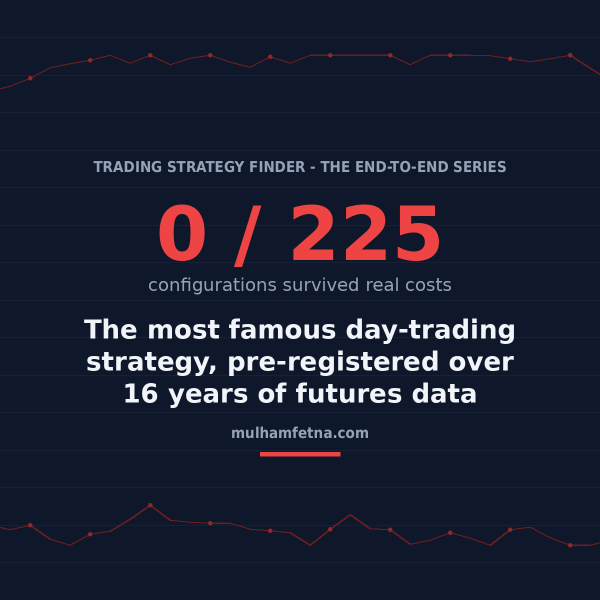
1. The famous stuff doesn’t survive costs. We pre-registered a 225-cell grid of opening-range breakout — the most-taught intraday strategy there is — over 16 years and nine futures markets. Zero cells passed at realistic costs; the grid earned +$1.57M gross and lost $6.49M net. The “edge” is smaller than the spread. Full story: the ORB null; the paper: https://papers.ssrn.com/sol3/papers.cfm?abstract_id=7428398.
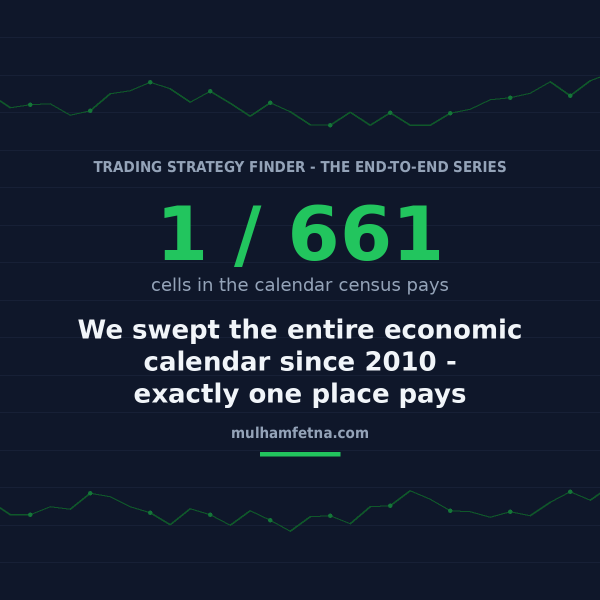
2. The economic calendar pays in exactly one place. We swept 612 market×news pairs and then a 661-cell census of every remaining combination. One place makes money after stressed costs: riding the US inflation (CPI) release on equity-index futures — a premium ordered by index sensitivity (Nasdaq > S&P > Dow > Russell), e.g. long NQ into the release at +$133 per event after stressed costs, t = 4.13, and ES alone at +$151 per event across 116 events (p = 0.0027). Everything else moves violently and pays nothing — and Retail Sales loses money on seven instruments in both directions. Full story: the calendar sweep.
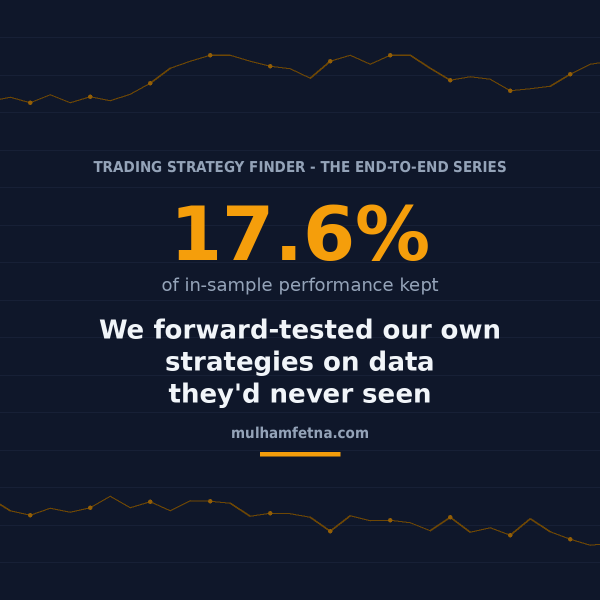
3. Our own optimized strategies decayed out-of-sample — and we published that. On a genuinely fresh forward window our 54 deployed configurations made 3,733 trades: +$29,807 raw, −$63,518 at $25 per round-trip — 17.6% of what the calibration window promised. Along the way the forward test caught a look-ahead bug in vendor data that had been silently inflating results. Full story: the forward test.
4. Honesty can be automated. The claims ledger, the falsifiers, the self-test that replays our own five historical mistakes and demands the gate reject each one for the right reason — the whole verification layer costs minutes per study and changed our conclusions more than once. That’s the part of this project we think generalizes far beyond trading. Full story: the claims ledger; the methodology paper: https://papers.ssrn.com/sol3/papers.cfm?abstract_id=7428478.
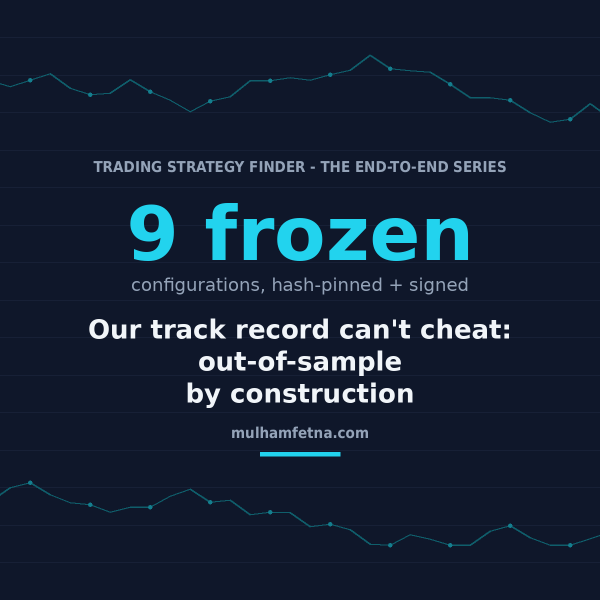
5. A track record you can’t cheat. The project’s final act: the surviving 9 of 54 configurations were frozen — parameters hash-pinned under a signed protocol — so every future evaluation window is out-of-sample by construction. The rules are public; a losing window gets published under the same rules as a winning one. Full story: the frozen track record.
What we’d tell anyone doing this kind of work #
Write the experiment down before you run it. State costs first, not last. Demand power before accepting a “no” and controls before believing a “yes”. Publish the nulls — ours turned out to be the most useful results we produced. And make the honesty mechanical, because willpower doesn’t survive a promising-looking backtest.
Everything is open under AGPL-3.0 (archived releases: DOI 10.5281/zenodo.21473312); the engine runs on your own data feed, and the entire claims ledger verifies offline without any market data.
This research was carried out at BeInMedia (Nmo AI), Kuwait • Dubai • Doha, by Mulham Fetna, with thanks to Abd Ulfatah Esper for project leadership and support.