
Three points make an angle #
An angle needs a vertex and two rays. A knuckle is the vertex; the two bones meeting there are the rays:
- a base point, where the previous bone starts,
- the vertex — the knuckle being measured,
- an end point, where the next bone ends.
flowchart LR
    P1(("p1
base")) -- "v1 = p1 − p2" --- P2(("p2
vertex
knuckle"))
    P2 -- "v2 = p3 − p2" --- P3(("p3
end"))
The triplet table #
self.finger_triplets = {
    "thumb":  [(0, 1, 2), (1, 2, 3), (2, 3, 4)],
    "index":  [(0, 5, 6), (5, 6, 7), (6, 7, 8)],
    "middle": [(0, 9, 10), (9, 10, 11), (10, 11, 12)],
    "ring":   [(0, 13, 14), (13, 14, 15), (14, 15, 16)],
    "pinky":  [(0, 17, 18), (17, 18, 19), (18, 19, 20)]
}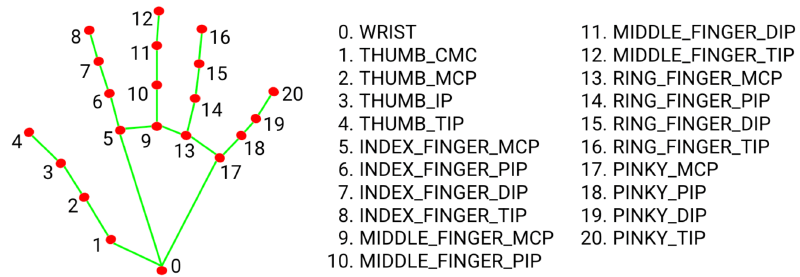
| Finger | Triplet | Vertex | Joint measured |
|---|---|---|---|
| Index | (0, 5, 6) | 5 | MCP — joins finger to palm |
| Index | (5, 6, 7) | 6 | PIP — middle knuckle |
| Index | (6, 7, 8) | 7 | DIP — fingertip knuckle |
| Thumb | (0, 1, 2) | 1 | CMC — saddle joint at the wrist |
| Thumb | (1, 2, 3) | 2 | MCP |
| Thumb | (2, 3, 4) | 3 | IP |
Why every first triplet starts at 0. The palm has no landmark of its own, so the wrist → knuckle line stands in for the metacarpal bone. It isn’t exactly collinear with a straight finger — ring and pinky metacarpals fan outward — so a relaxed straight finger rarely measures a full \(\pi\). That’s part of why the calibrated “straight” threshold is 3.10 rad rather than 3.14.
The function, line by line #
def _calculate_angle(self, p1, p2, p3):
    v1 = p1 - p2                    # ray back along the previous bone
    v2 = p3 - p2                    # ray out along the next bone
    norm1 = np.linalg.norm(v1)
    norm2 = np.linalg.norm(v2)
    if norm1 < 1e-6 or norm2 < 1e-6:
        return 0.0                  # trap 1: a zero-length bone
    cosang = np.dot(v1, v2) / (norm1 * norm2)
    cosang = np.clip(cosang, -1.0, 1.0)   # trap 2: floating-point overshoot
    return float(np.arccos(cosang))
It is the definition of the dot product, rearranged:
$$\cos\theta = \frac{\vec v_1 \cdot \vec v_2}{\lVert \vec v_1 \rVert\,\lVert \vec v_2 \rVert} \qquad\Longrightarrow\qquad \theta = \arccos\!\left(\frac{\vec v_1 \cdot \vec v_2}{\lVert \vec v_1 \rVert\,\lVert \vec v_2 \rVert}\right)$$Interior angle, not bend angle #
The result is the interior angle between the bones, which runs the opposite way from the “bend” a physiotherapist would quote:
| Finger | Bones | Interior \(\theta\) | Bend \(\pi - \theta\) |
|---|---|---|---|
| Perfectly straight | opposite directions | \(\pi\) = 180° | 0° |
| Right angle | perpendicular | \(\pi/2\) = 90° | 90° |
| Folded flat | same direction | 0 | 180° |
Larger number, straighter finger. Keep that inversion in mind — it’s why the normalization in Part 7 subtracts from the straight limit.
Worked example #
An index finger, in normalized image coordinates (z omitted for readability):
| Landmark | x | y |
|---|---|---|
| 5 (MCP) | 0.50 | 0.60 |
| 6 (PIP) | 0.50 | 0.50 |
| 7 (DIP) | 0.55 | 0.45 |
For the PIP joint, triplet (5, 6, 7) with vertex 6:
An interior angle of 135° — a 45° bend.
The two numerical traps #
1. Zero-length vectors. If two landmarks coincide — a glitchy frame, or a finger foreshortened
straight at the lens — a norm is zero and the division yields NaN. The guard returns 0.0. Note
what that means here: 0 rad is “folded flat”, so a degenerate frame briefly reads as a curled joint.
After averaging and clipping, the cost is one frame of partial flexion instead of a crash.
2. arccos outside its domain. Rounding can produce a cosine of 1.0000000002, and
np.arccos of that is NaN. np.clip(cosang, -1, 1) makes it impossible. Without the clip, a
perfectly straight finger intermittently produces NaN, which would propagate straight into the
tendon force.
Both guards are unglamorous and non-optional in anything that ends at an actuator.
Next #
One finger now has three angles — but it only has one tendon. Part 6 collapses them.