
The shipped thresholds were measured on one hand with one webcam. Here is how to measure yours — and
what a live recording revealed about how far off “good enough” can be while the twin still looks
perfect.
Symptoms that call for calibration #
| What you see in the published flexions | Cause | Change |
|---|---|---|
| A fist, but flexion stays below 1.0 | your fist angle is above the curled limit | raise *_CURLED_ANGLE to your fist reading |
| Flexion hits 1.0 with the hand half closed | curled limit too high | lower *_CURLED_ANGLE |
| Flexion above 0 with a relaxed open hand | your open angle is below the straight limit | lower *_STRAIGHT_ANGLE to your open reading |
| The thumb flickers | thumb window too narrow for your jitter | widen it (Part 8) |
Calibrate against the numbers, not the render. With the current force-control tuning, the
simulated finger snaps shut past flexion ≈ 0.51 (Part 11),
so most calibration errors are invisible in the viewer. Watch
ros2 topic echo /hand/target_flexions.
Real data: what a live session produced #
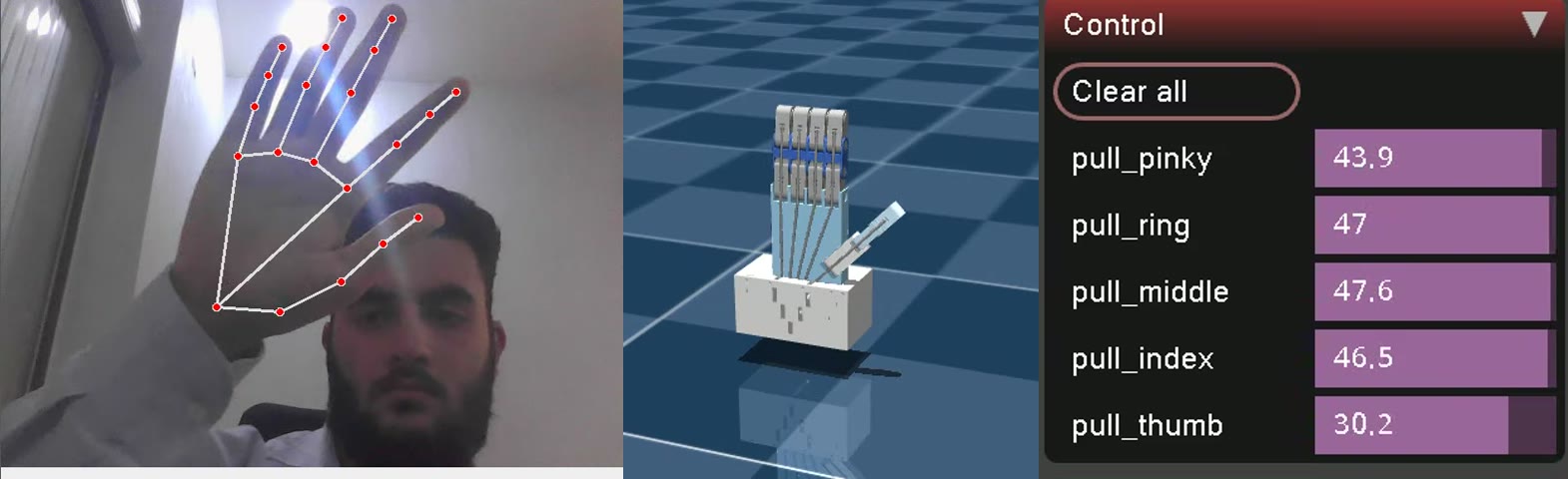
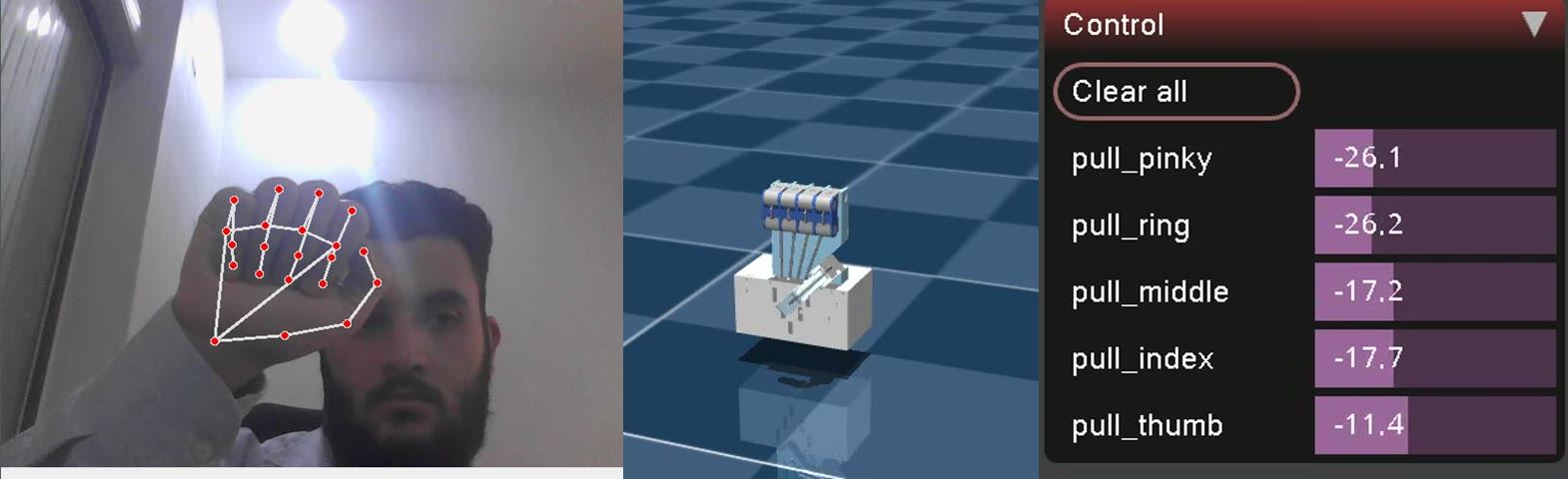
MuJoCo’s viewer has a Control panel showing the live force of every motor. Since the force is \(F = 50 - 100 \cdot \text{flexion}\), every recorded frame gives back the exact flexion the tracker published: flexion = (50 − F) / 100.
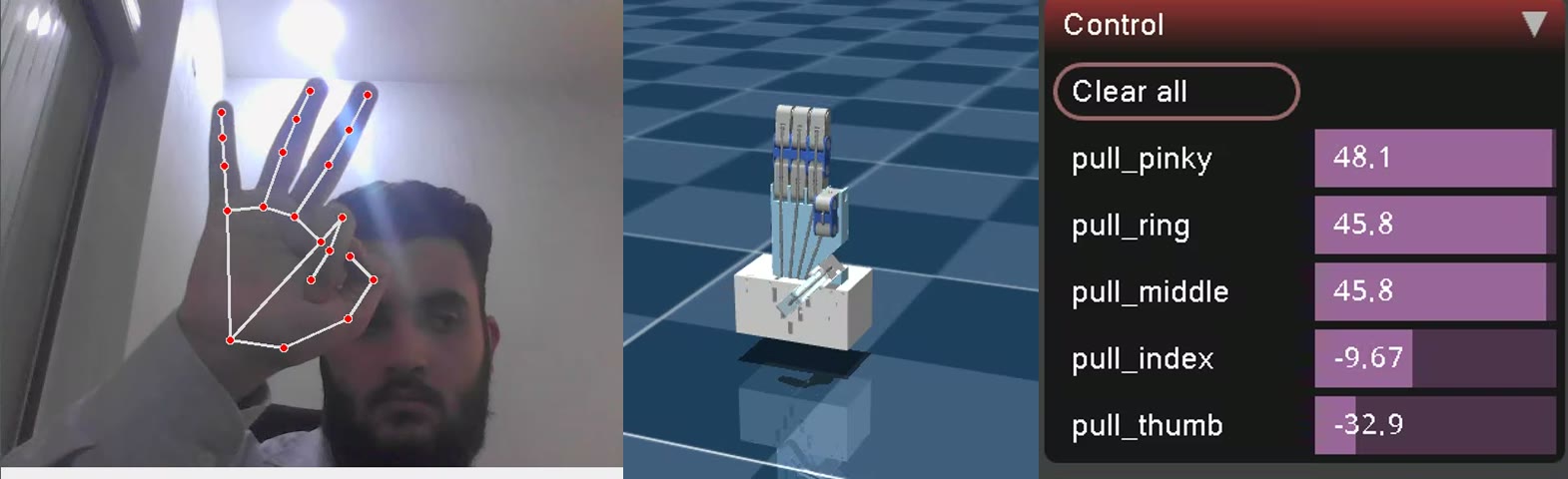
| Pose | pinky | ring | middle | index | thumb |
|---|---|---|---|---|---|
| Open hand | +43.9 N → 0.06 | +47.0 N → 0.03 | +47.6 N → 0.02 | +46.5 N → 0.04 | +30.2 N → 0.20 |
| Peace sign | −21.0 N → 0.71 | −20.9 N → 0.71 | +39.1 N → 0.11 | +44.4 N → 0.06 | +43.8 N → 0.06 |
| Fist | −26.1 N → 0.76 | −26.2 N → 0.76 | −17.2 N → 0.67 | −17.7 N → 0.68 | −11.4 N → 0.61 |
| OK sign | +48.1 N → 0.02 | +45.8 N → 0.04 | +45.8 N → 0.04 | −9.7 N → 0.60 | −32.9 N → 0.83 |
| Thumb curled | +47.5 N → 0.03 | +47.3 N → 0.03 | +47.5 N → 0.03 | +45.2 N → 0.05 | −19.5 N → 0.69 |
Reading it like a calibrator:
- The open hand is well calibrated — fingers at 0.02–0.06. The thumb at 0.20 means this
operator’s relaxed thumb sits about 0.12 rad below
THUMB_STRAIGHT_ANGLE; lowering it by ~0.1 brings the open thumb to ~0. - The fist never reaches 1.0. Fingers top out at 0.67–0.76, the thumb at 0.61 — the fist angles
sit above the curled limits. Raising
RAW_CURLED_ANGLE(andTHUMB_CURLED_ANGLE) toward the measured fist values would use the full range. - Middle and index curl less than ring and pinky in the same fist (0.67 vs 0.76) — an argument for per-finger windows.
- The twin still looked right in every pose, because anything above ~0.51 already closes a finger. These gaps only become visible once actuation is proportional.
The procedure #
-
1 · Print the raw angles
Temporary diagnostic in get_finger_flexions
for finger_name, triplets in self.finger_triplets.items():
    angles = [self._calculate_angle(lm[p1], lm[p2], lm[p3]) for p1, p2, p3 in triplets]
    avg_angle = np.mean(angles)
    print(f"{finger_name:>6}: {avg_angle:.2f}", end="  ")   # TEMPORARY
Add a bare
print()after the loop to end the line. -
2 · Run it
Standalone for the fastest feedback
env -u PYTHONPATH venv/bin/python standalone/main.py— or in containers,docker compose up vision_trackeranddocker compose logs -f vision_tracker. -
3 · Measure open
Relaxed, not hyperextended
Hold your hand the way you’ll hold it while operating. Read the value each finger settles around — typically 3.0–3.1 for fingers and 2.7–3.0 for the thumb. These becomeRAW_STRAIGHT_ANGLEandTHUMB_STRAIGHT_ANGLE. -
4 · Measure closed
A comfortable full fist, thumb tucked
Typically 1.5–1.8 for fingers and 2.1–2.4 for the thumb. These becomeRAW_CURLED_ANGLEandTHUMB_CURLED_ANGLE. -
5 · Write the constants — in every copy
Leave a 0.05 rad margin
Set the straight limit ~0.05 rad below your open reading and the curled limit ~0.05 rad above your fist reading, so relaxed poses reliably clip to exactly 0 and 1. The constants live instandalone/main.py,vision_tracker/src/vision_tracker_node.py, and the guard indocs/tools/make_figures.py. For the container,docker compose restart vision_tracker— no rebuild. -
6 · Remove the print
Printing 30 times a second costs real time in the loop.
Going further: per-finger windows #
The data above already argues for it:
CALIBRATION = {                     # (straight, curled) in radians — measure your own
    "thumb":  (2.80, 2.50),
    "index":  (3.10, 2.10),
    "middle": (3.10, 2.10),
    "ring":   (3.10, 1.95),
    "pinky":  (3.10, 1.95),
}
(Values back-computed from the live table above — e.g. a finger fist flexion of 0.67 means an average angle of 3.10 − 0.67 × 1.50 ≈ 2.10 rad. Measure your own rather than copying.) In production these belong in a ROS 2 parameter file, so recalibrating never touches source code.