
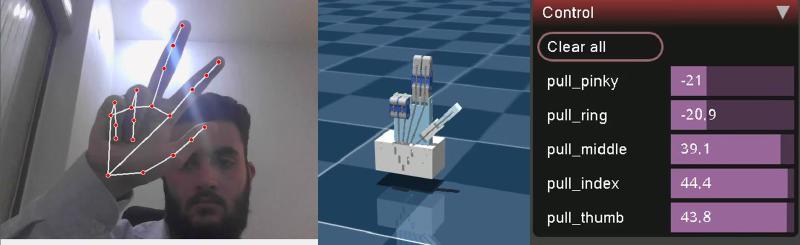
The whole ROS 2 layer is one topic carrying five numbers. The interesting decisions are what those
numbers mean, which message type carries them, and how to run a ROS subscriber when a 3D viewer owns
your main thread.
Why ROS 2 between vision and physics at all? #
The single-process script works well. Splitting it across ROS 2 buys:
| Benefit | Concretely |
|---|---|
| Process isolation | a MediaPipe crash doesn’t kill the simulator, and vice versa |
| Independent environments | vision and physics get their own container, dependencies and restarts |
| Swappable endpoints | replace the twin with a servo driver, or the tracker with a data glove |
| Free observability | ros2 topic echo, hz, bag record on the live stream |
| Network transparency | any machine on the LAN can subscribe |
The costs — a bigger stack, DDS configuration, one more hop — are small next to 19–85 ms of inference (Part 19).
The node graph #
flowchart LR
    subgraph C1["🐳 vision_tracker"]
        V["/vision_tracker_node
timer · 30 Hz"]
    end
    subgraph C2["🐳 mujoco_twin"]
        T["/mujoco_twin_node
spin_once in viewer loop"]
    end
    V -- "/hand/target_flexions
sensor_msgs/JointState · depth 10" --> T
    V -. "any LAN subscriber
ROS_DOMAIN_ID=42" .-> X["ros2 topic echo · rosbag
future servo driver"]
The contract #
| Field | Value |
|---|---|
| Topic | /hand/target_flexions |
| Type | sensor_msgs/msg/JointState |
| Publisher | vision_tracker_node, timer at 30 Hz — effective rate bounded by inference |
| Subscriber | mujoco_twin_node |
| QoS | default reliable, keep-last 10 |
header.stamp |
publisher clock at publish time |
name |
["thumb", "index", "middle", "ring", "pinky"] |
position |
flexion per finger, 0.0 open … 1.0 closed, same order as name |
velocity, effort |
empty |
A real message, captured with ros2 topic echo during testing (published by hand with ros2 topic pub,
hence the zero stamp):
header:
  stamp: {sec: 0, nanosec: 0}
  frame_id: ''
name: [thumb, index, middle, ring, pinky]
position: [0.1, 0.2, 0.3, 0.4, 0.5]
velocity: []
effort: []
Why JointState — and why flexions, not radians
#
- A stock message means no custom package — no
colcon build, norosidlstep, no message definitions duplicated across containers, and every ROS tool already understands it. positionholds unitless flexions, not joint radians. The names are fingers, not model joints. That keeps the vision side ignorant of the robot’s joint structure.- Don’t remap it onto
/joint_states—robot_state_publisherwould treat the values as radians for joints that don’t exist. - Names travel with values. The subscriber zips
nameandposition, so order doesn’t matter and unknown names are ignored.
The publisher: timer-driven #
class VisionTrackerNode(Node):
    def __init__(self):
        super().__init__("vision_tracker_node")
        self.tracker = HandTracker(CAMERA_INDEX)
        self.publisher = self.create_publisher(JointState, TOPIC, 10)
        self.timer = self.create_timer(PUBLISH_PERIOD, self.timer_callback)   # 1/30 s

    def timer_callback(self):
        ret, frame = self.tracker.cap.read()
        ...
        flexions, annotated_frame = self.tracker.get_finger_flexions(frame)
        msg = JointState()
        msg.header.stamp = self.get_clock().now().to_msg()
        msg.name = FINGERS
        msg.position = [flexions[f] for f in FINGERS]
        self.publisher.publish(msg)
        cv2.imshow("MediaPipe Hand Tracker", annotated_frame)
        if cv2.waitKey(1) & 0xFF == 27:
raise KeyboardInterrupt # ESC shuts the node down cleanly- Single-threaded executor. When a callback overruns its 33 ms period — as it does at ~85 ms with the viewer open — ticks don’t pile up into a backlog of stale frames.
- The camera read lives in the callback. Simple and correct at this rate; production would grab frames on a thread and always process the newest.
- Knobs:
CAMERA_INDEX(default 0) andVISION_RATE_HZ(default 30), set from Compose.
The subscriber: pumped from inside a render loop #
def main():
    rclpy.init()
    sim = DigitalTwin(SCENE_XML)
    node = MujocoTwinNode(sim)
    with mujoco.viewer.launch_passive(sim.model, sim.data) as viewer:
        start_time = time.time()
        while viewer.is_running() and rclpy.ok():
            rclpy.spin_once(node, timeout_sec=sim.model.opt.timestep)   # wait ≤ 2 ms for a message
            sim.step_physics(start_time)                                 # catch physics up to wall clock
            viewer.sync()
Why not
rclpy.spin(node)? The passive viewer’s loop needs the main thread, and spin() would
block it forever. So ROS is pumped from inside the render loop, one spin_once per iteration.
timeout_sec = timestep. A zero timeout lets the loop spin as fast as Python allows; waiting up to one physics step (2 ms) when idle still reacts within ~2 ms. Even so, the main thread measured ~90% of one core, because every iteration also steps and syncs — capping the loop at display rate is a cheap improvement.- Real-time stepping.
mj_stepruns untildata.timecatches up with wall-clock time, so the simulation runs at 1× regardless of loop rate. - The callback only writes
data.ctrl— no stepping, no rendering — so it takes microseconds. - The last command holds. If the publisher dies, the motors keep their last forces, and with the switch-like physics the hand freezes in its last pose. A watchdog is on the roadmap.
Observe it, poke it #
From inside either container — or any LAN machine with ROS 2 Jazzy and ROS_DOMAIN_ID=42:
docker compose exec mujoco_twin bash
source /opt/ros/jazzy/setup.bash

ros2 node list                              # /vision_tracker_node  /mujoco_twin_node
ros2 topic info -v /hand/target_flexions    # endpoints and QoS
ros2 topic hz /hand/target_flexions         # 30.0 Hz alone · 10.7 Hz with the viewer open
ros2 topic echo /hand/target_flexions

# drive the twin with no camera: index and thumb closed
ros2 topic pub -r 10 /hand/target_flexions sensor_msgs/msg/JointState \
  "{name: [thumb, index, middle, ring, pinky], position: [1.0, 1.0, 0.0, 0.0, 0.0]}"

# record a session to replay into the twin later
ros2 bag record /hand/target_flexions
ros2 topic pub plus docker compose up mujoco_twin is the fastest way to develop the simulation
side without a webcam.