
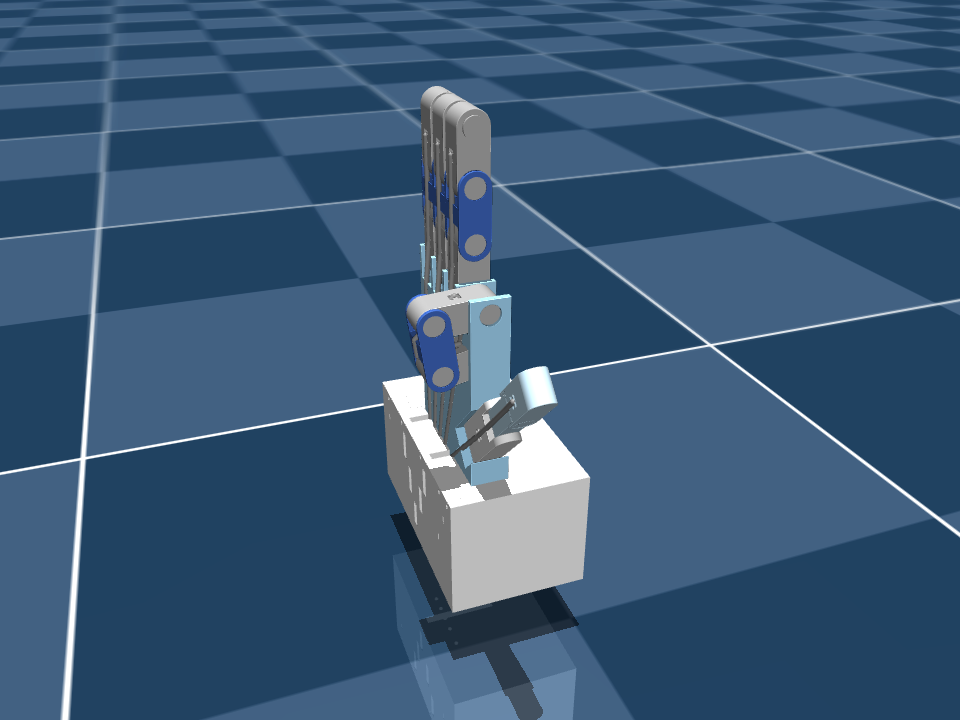
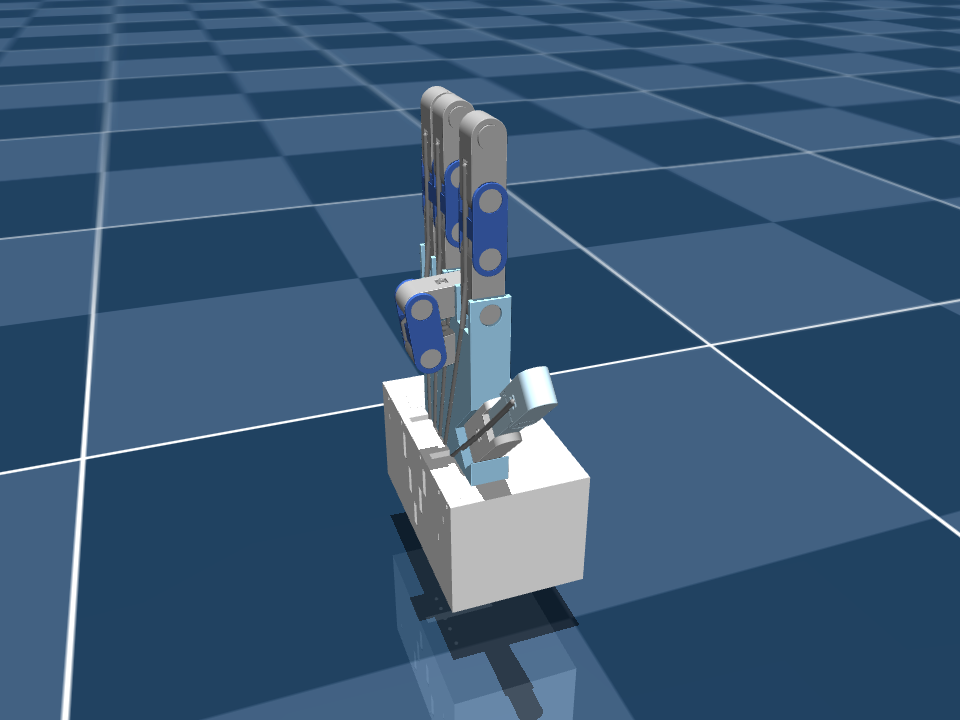
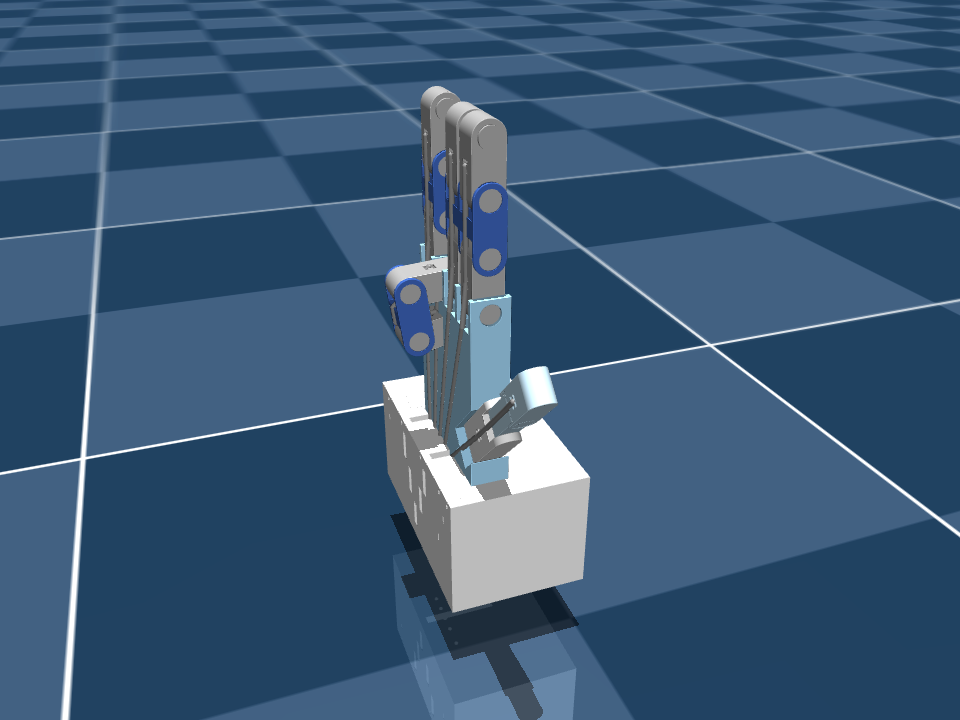
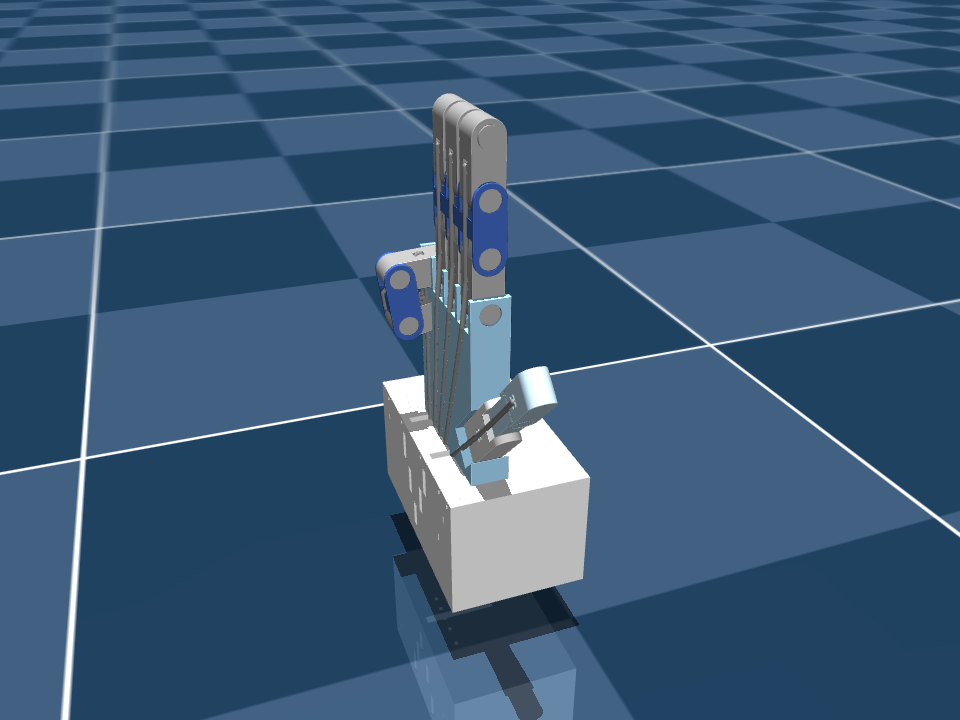
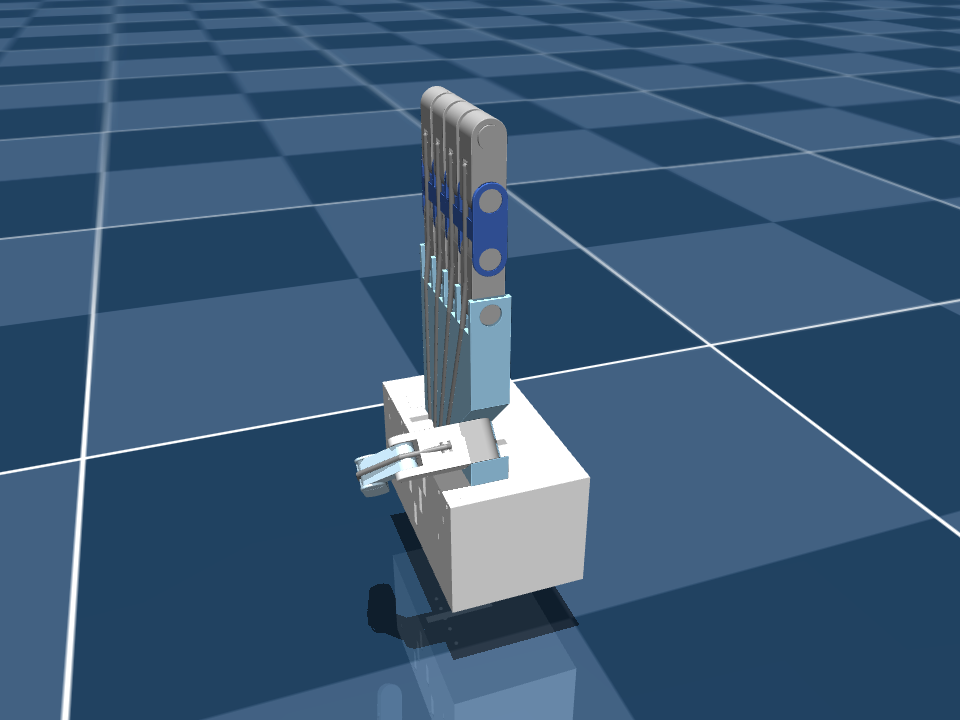
At a glance #
| Quantity | Value | Notes |
|---|---|---|
| Bodies | 22 | world, palm, 15 phalanges, 5 servo horns |
| Joints / DoF | 20 / 20 | all hinges; no free joint — the palm is welded to the world |
| Knuckle joints | 15 | passive, 90° limits |
| Servo horn joints | 5 | unlimited and unactuated |
| Geoms | 87 | 43 visual + 43 collision meshes + floor |
| Meshes | 14 | STL |
| Sites | 70 | tendon via-points and anchors |
| Tendons | 10 | 5 flexor (actuated) + 5 extensor (passive) |
| Actuators | 5 | <motor> on flexors, ±50 N |
| Timestep / integrator | 0.002 s / Euler | 500 steps per simulated second |
| Total mass | 0.398 kg | palm block 341.8 g |
The kinematic tree #
flowchart TB
    W["world"] --> P["part_1 · palm + servo block
341.8 g · 20 sites"]
    P --> I1["part_2_4 · index proximal
4.6 g · index_mcp"] --> I2["part_3_4
1.8 g · index_pip"] --> I3["part_4_4
4.6 g · index_dip"]
    P --> M1["part_2_3 · middle
middle_mcp"] --> M2["part_3_3
middle_pip"] --> M3["part_4_3
middle_dip"]
    P --> R1["part_2_2 · ring
ring_mcp"] --> R2["part_3_2
ring_pip"] --> R3["part_4_2
ring_dip"]
    P --> K1["part_2 · pinky
pinky_mcp"] --> K2["part_3
pinky_pip"] --> K3["part_4
pinky_dip"]
    P --> T1["part_5 · thumb
5.4 g · thumb_cmc"] --> T2["part_6
2.4 g · thumb_mp"] --> T3["part_7
2.5 g · thumb_ip"]
    P --> H["servo_horn … servo_horn_5
0.3 g each"]
_2, _3, … appended, so
the pinky chain is part_2 → part_3 → part_4 and the index chain is part_2_4 → part_3_4 → part_4_4.
Address joints, sites, tendons and actuators in code — never bodies.
Joints and their signs #
| Joint | Range (rad) | Bend direction |
|---|---|---|
index_mcp, index_pip, index_dip |
[−1.571, 0] | negative |
middle_mcp |
[−1.571, 0] | negative |
middle_pip, middle_dip |
[0, +1.571] | positive |
ring_mcp, ring_dip |
[−1.571, 0] | negative |
ring_pip |
[0, +1.571] | positive |
pinky_mcp, pinky_dip |
[−1.571, 0] | negative |
pinky_pip |
[0, +1.571] | positive |
thumb_cmc, thumb_mp, thumb_ip |
[−1.571, 0] | negative |
servo_* × 5 |
unlimited | — |
Bend direction is inconsistent, because each Onshape mate’s axis was exported as-is. Anything that reads joint angles must normalize per joint:
direction = 1.0 if model.jnt_range[jid][1] > 1e-6 else -1.0   # [0, +90°] → +1 ; [-90°, 0] → -1
bend_deg = np.degrees(direction * data.qpos[model.jnt_qposadr[jid]])
Readings just beyond the range — 94° at −50 N, −3° at +50 N — are MuJoCo soft limits: constraint force grows with penetration rather than acting as a rigid wall.
Site naming #
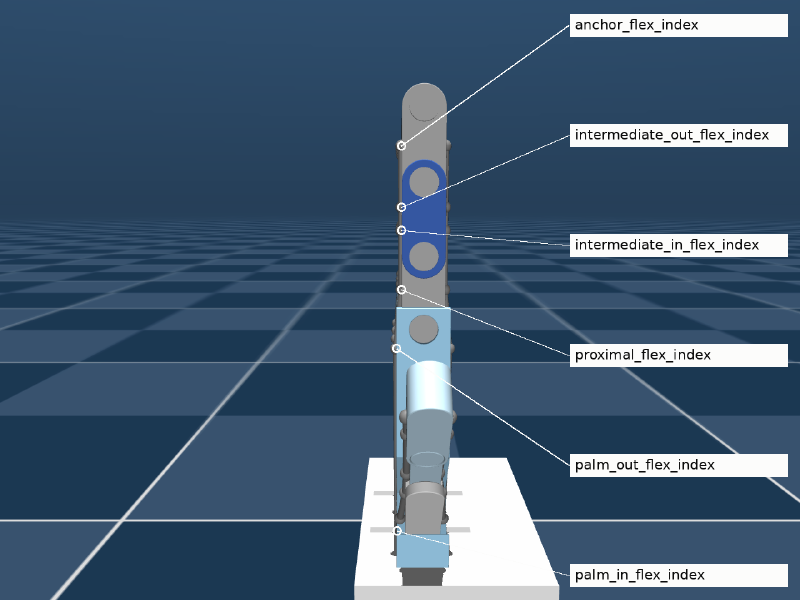
Every site follows {segment}_{role}_{finger}:
| Segment | Role | Finger |
|---|---|---|
horn · palm_in · palm_out · proximal · intermediate_in · intermediate_out · anchor |
flex · ext |
thumb · index · middle · ring · pinky |
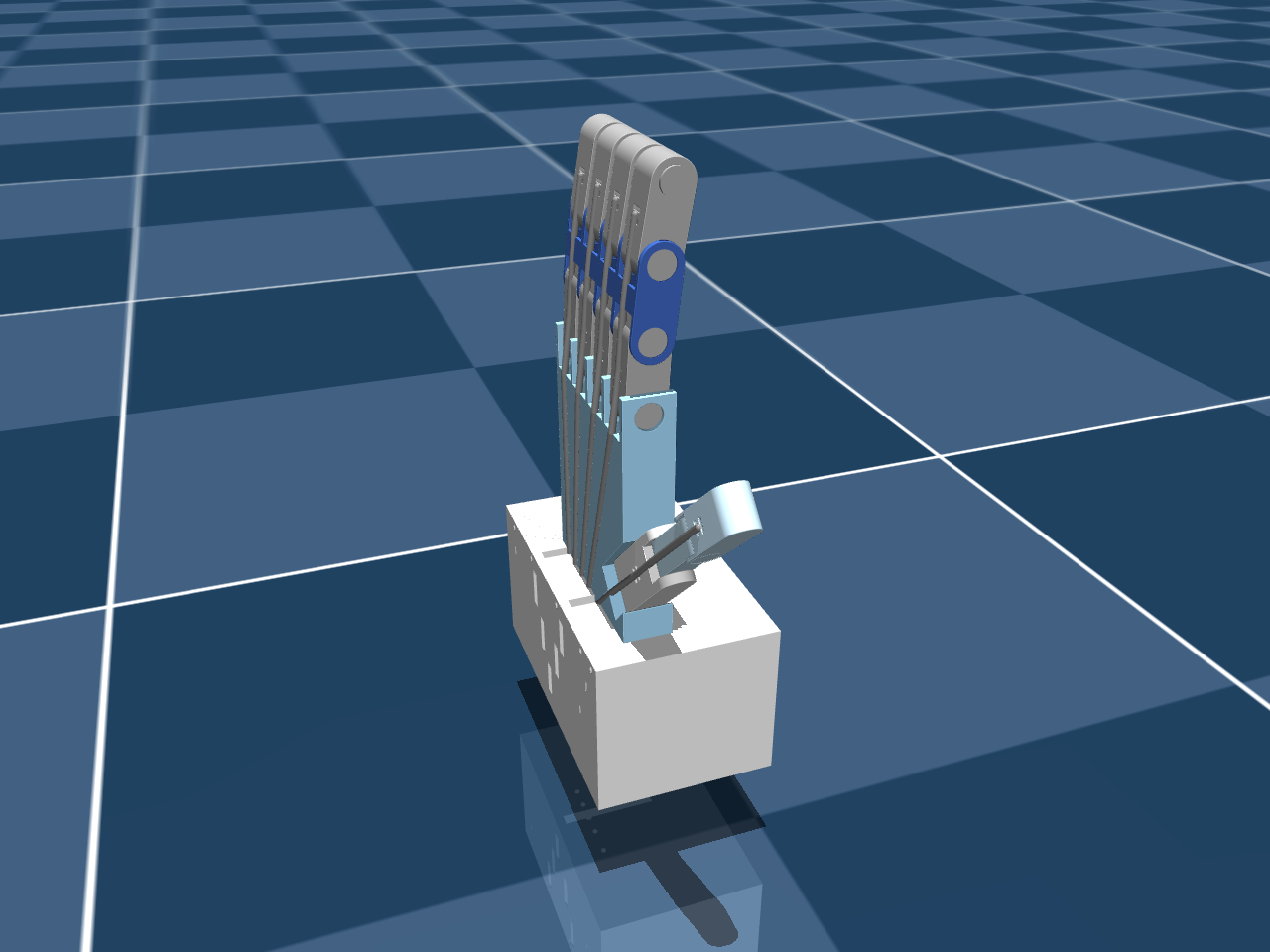
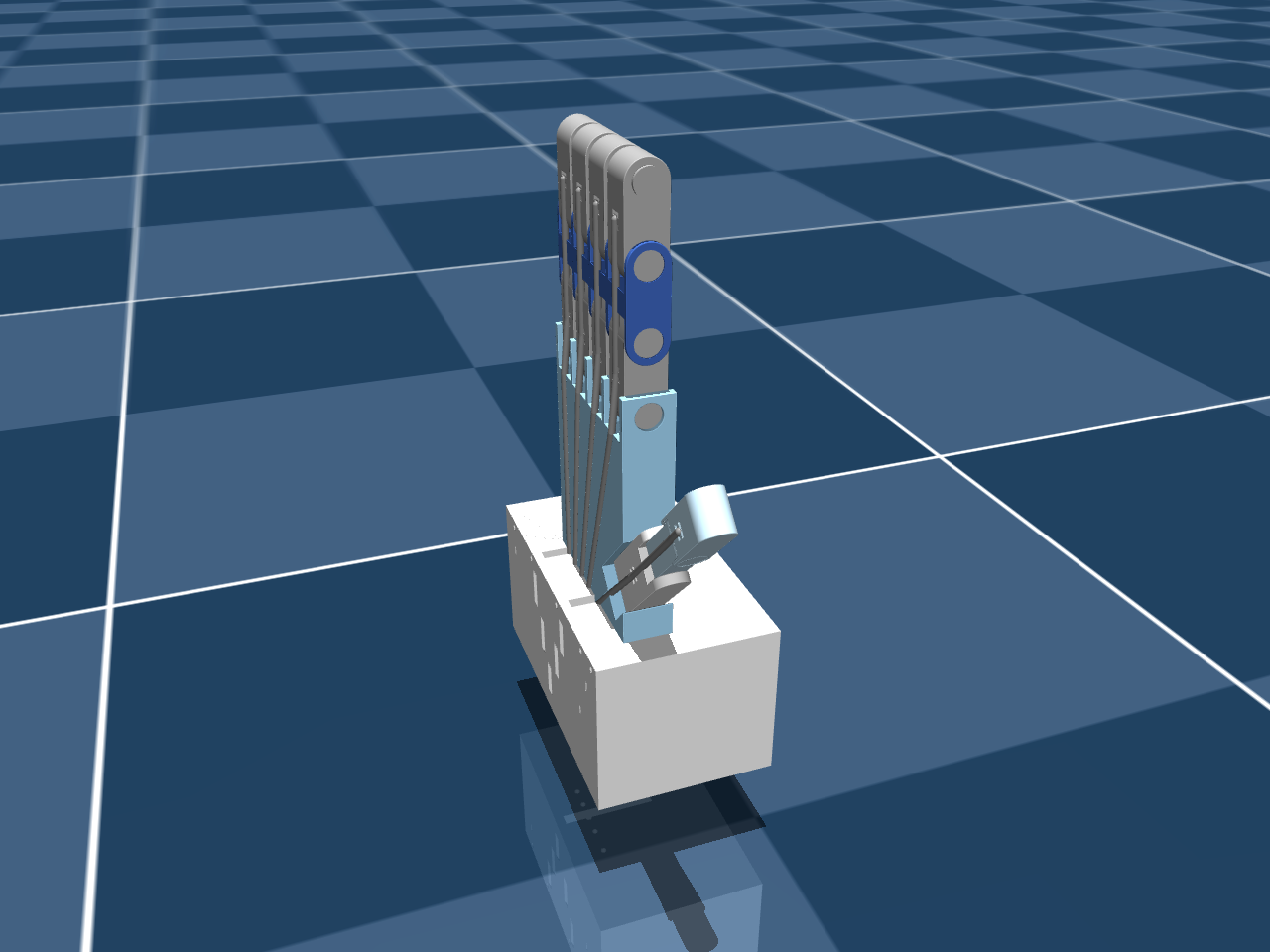
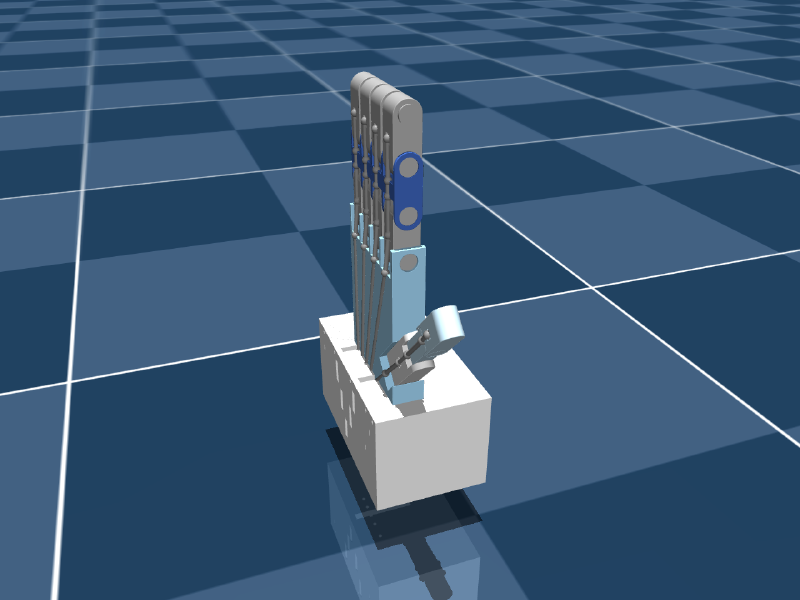
7 × 2 × 5 = 70 sites: 20 on the palm, 2 per proximal phalanx, 4 per intermediate, 2 per distal, 2 per servo horn.
| The index flexor’s route | Every site on the hand |
|---|---|
 |
 |
Tendons at rest #
| Tendon (flexor / extensor) | Rest length (m) | Stiffness (N/m) | Damping |
|---|---|---|---|
| index | 0.1283 / 0.1283 | 15 | 0.05 |
| middle | 0.1260 / 0.1260 | 15 | 0.05 |
| ring | 0.1245 / 0.1245 | 15 | 0.05 |
| pinky | 0.1241 / 0.1241 | 15 | 0.05 |
| thumb | 0.0843 / 0.0844 | 15 | 0.05 |
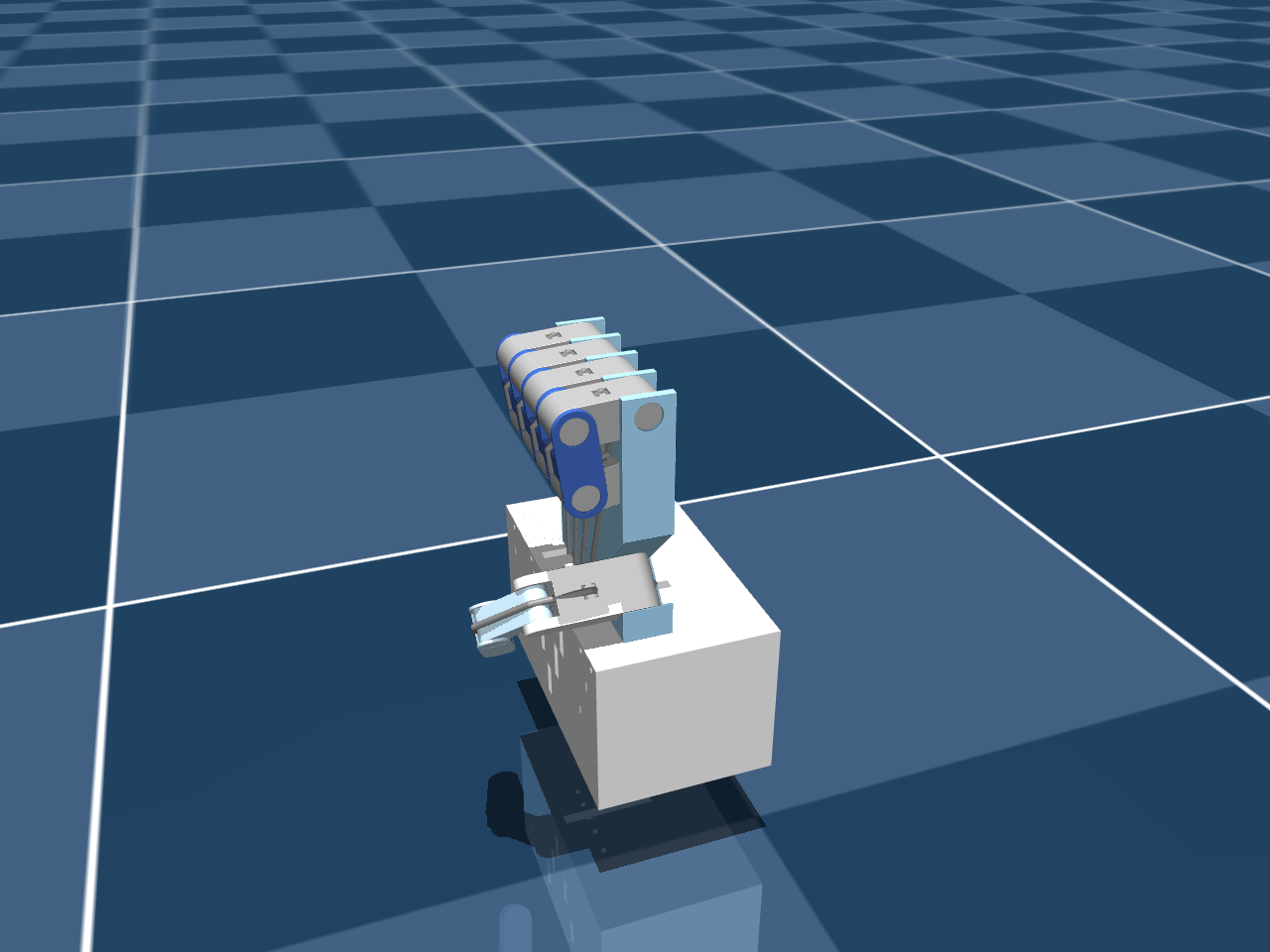
The index flexor measures 0.1294 m pushed open and 0.0870 m in a full fist — a 42 mm stroke, which is what a hardware servo horn would have to wind.
Visual and collision geoms #
| Class | group |
contype / conaffinity |
Visible by default |
|---|---|---|---|
visual |
2 | 0 / 0 | yes |
collision |
3 | 1 / 0 | no — toggle group 3 |
Both use the same STL meshes. Because robot collision geoms can never match each other, there is no self-contact (Part 13).
Poke it yourself #
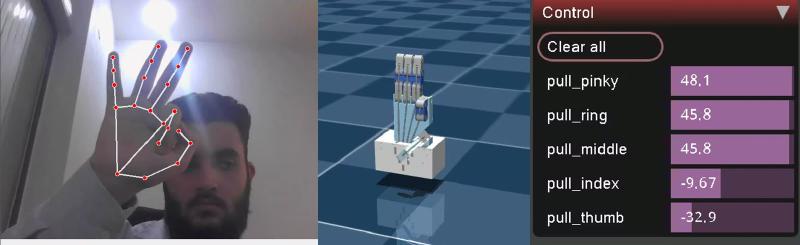
env -u PYTHONPATH venv/bin/python -m mujoco.viewer --mjcf=mujoco_twin/model/scene.xmlRendering → Tendon shows the strings, site groups show the via-points, geom group 3 shows
collision meshes, and the Control panel drives pull_* by hand — the same panel the ROS node drives
live: