
Which edits survive a re-export #
flowchart TB
    subgraph generated["robot.xml — regenerated by onshape-to-robot"]
        D["① joint defaults
manual — re-apply"]
        T["② tendons + ③ contacts
auto-injected from tendons.xml"]
        B["bodies · joints · sites · meshes
generated"]
        A["④ actuators
manual — re-apply"]
    end
    S["⑤ scene.xml
floor · lights · skybox
never regenerated"] -->|"include robot.xml"| generated
| # | Edit | Lives in | Survives re-export? |
|---|---|---|---|
| ① | Joint friction / armature / damping defaults | robot.xml <default> |
✘ re-apply |
| ② | Flexor + extensor spatial tendons | tendons.xml → injected |
✔ |
| ③ | Contact exclusions | tendons.xml → injected |
✔ |
| ④ | Five tendon motors | robot.xml <actuator> |
✘ re-apply |
| ⑤ | Environment | scene.xml |
✔ separate file |
tendons.xml is kept byte-identical to the <tendon> and <contact> region of robot.xml. Tune a
tendon in robot.xml without copying it back and the next export silently reverts it.
① Joint defaults — stability #
<default class="ros2-tendon-driven-hand-gazebo-digital-twin">
<joint frictionloss="0.001" armature="0.0001" damping="0.01"/>| Attribute | Value | Role |
|---|---|---|
damping |
0.01 N·m·s/rad | stops a 2 g phalanx reaching absurd speed when 50 N yanks it |
armature |
0.0001 kg·m² | rotor-like inertia on each joint’s diagonal — conditions the solver for very light bodies |
frictionloss |
0.001 N·m | a small dry-friction dead-band so joints settle instead of creeping |
Phalanges weigh 1.8–5.4 g. Without these, tiny inertias under large tendon forces blow up the
integrator — an earlier, larger revision of the model logged
Nan, Inf or huge value in QACC at DOF 128. The simulation is unstable.
② Tendons — a flexor and an extensor per finger #
<spatial width="0.001" name="tendon_flex_index" stiffness="15" damping="0.05">
  <!-- <site site="horn_flex_index"/> -->
  <site site="palm_in_flex_index"/>
  <site site="palm_out_flex_index"/>
  <site site="proximal_flex_index"/>
  <site site="intermediate_in_flex_index"/>
  <site site="intermediate_out_flex_index"/>
  <site site="anchor_flex_index"/>
</spatial>
A spatial tendon is the shortest path through an ordered list of sites. Its length changes as the bodies carrying those sites move, and a force along it becomes joint torque through the moment arm at each site.
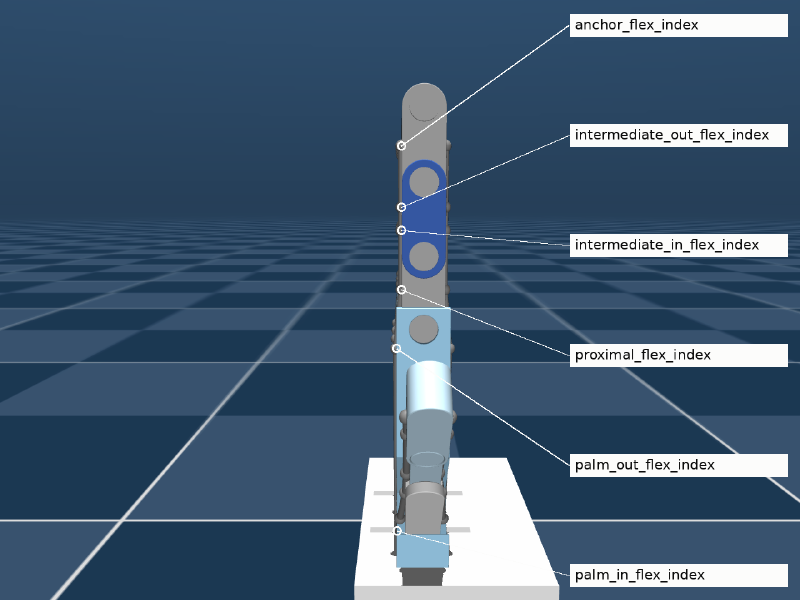
| Site | On body | Purpose |
|---|---|---|
palm_in, palm_out |
palm | entry and exit of the palm channel |
proximal |
proximal phalanx | moment arm for the MCP joint |
intermediate_in, intermediate_out |
intermediate phalanx | moment arm for the PIP joint |
anchor |
distal phalanx | termination — its pull bends the DIP |
| Attribute | Value | Meaning |
|---|---|---|
width |
0.001 m | render thickness only — the 1 mm strings in the viewer |
stiffness |
15 N/m | spring along the tendon, around its initial length |
damping |
0.05 N·s/m | velocity damping along the tendon |
The “horn hack” #
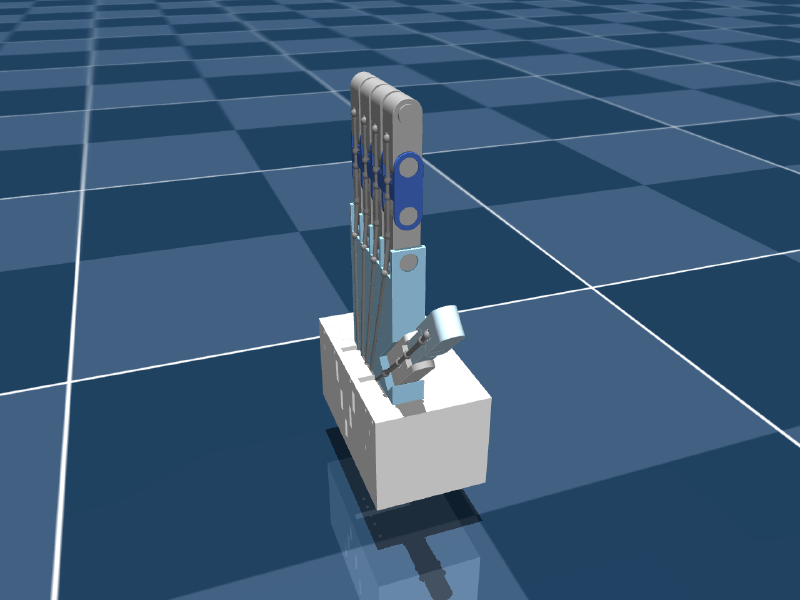
The first site of every tendon — horn_*, on the servo horn — is commented out:
- With it, a tendon starts on a rotating horn: you’d need a position-controlled
servo_*hinge and rotary-to-linear string kinematics. - Without it, the tendon starts at the fixed palm entry, and a linear motor pulls it directly.
The control problem becomes “pull this string with F newtons.” The price: the horns in the model are decorative and spin freely. Restoring the horn sites with position servos is the path to a hardware-faithful twin.
③ Contact exclusions — redundant, and why #
<contact>
  <exclude body1="part_1" body2="servo_horn"/>
  <exclude body1="part_1" body2="servo_horn_2"/>
  <exclude body1="part_1" body2="servo_horn_3"/>
  <exclude body1="part_1" body2="servo_horn_4"/>
  <exclude body1="part_1" body2="servo_horn_5"/>
</contact>
These were added to stop the flush-mounted horns being blasted out of the palm by contact forces. In the current model they change nothing, for two independent reasons:
- Parent–child filtering. Every horn is a direct child of
part_1, and MuJoCo skips parent–child contacts by default. - The collision class can’t self-collide. The export’s default is
<geom group="3" contype="1" conaffinity="0"/>. Two geoms collide only if(contype₁ & conaffinity₂) || (contype₂ & conaffinity₁)— withconaffinity=0on both, never.
Verified directly: 0 contacts at the open pose and at the full fist.
conaffinity="1", and give finger collision geoms
conaffinity="1" if they should collide with each other.
④ Tendon motors #
<actuator>
  <motor class="ros2-tendon-driven-hand-gazebo-digital-twin" name="pull_pinky"  tendon="tendon_flex_pinky"  ctrlrange="-50 50"/>
  <motor class="ros2-tendon-driven-hand-gazebo-digital-twin" name="pull_ring"   tendon="tendon_flex_ring"   ctrlrange="-50 50"/>
  <motor class="ros2-tendon-driven-hand-gazebo-digital-twin" name="pull_middle" tendon="tendon_flex_middle" ctrlrange="-50 50"/>
  <motor class="ros2-tendon-driven-hand-gazebo-digital-twin" name="pull_index"  tendon="tendon_flex_index"  ctrlrange="-50 50"/>
  <motor class="ros2-tendon-driven-hand-gazebo-digital-twin" name="pull_thumb"  tendon="tendon_flex_thumb"  ctrlrange="-50 50"/>
</actuator>
A <motor> is a direct force actuator — force = gear × ctrl — along the tendon. Only flexors are
actuated; extensors are passive. Names are the API: the Python looks up pull_{finger}.
⑤ scene.xml — keep the world out of the generated file
#
<mujoco model="scene">
  <include file="robot.xml"/>
  <visual>
    <headlight diffuse="0.6 0.6 0.6" ambient="0.3 0.3 0.3" specular="0 0 0"/>
    <global azimuth="160" elevation="-20"/>
  </visual>
  <!-- skybox texture, checker ground material -->
  <worldbody>
    <light pos="0 0 3.5" dir="0 0 -1" directional="true"/>
    <geom name="floor" size="0 0 0.05" type="plane" material="groundplane"/>
  </worldbody>
</mujoco>
A re-export never touches lights or floor. Always load scene.xml.
Re-export checklist #
-
1 · Commit
So the export is a reviewable diff. -
2 · Check tendons.xml
Edits ② and ③ are injected from it. -
3 · Export
onshape-to-robot mujoco_twin/model -
4 · Re-apply ① and ④
Joint defaults in the default class; the<actuator>block, replacing generated servo actuators. -
5 · Verify
Loadscene.xmland expectntendon=10,nu=5; re-rundocs/tools/make_figures.py all. -
6 · Restart
docker compose restart mujoco_twin