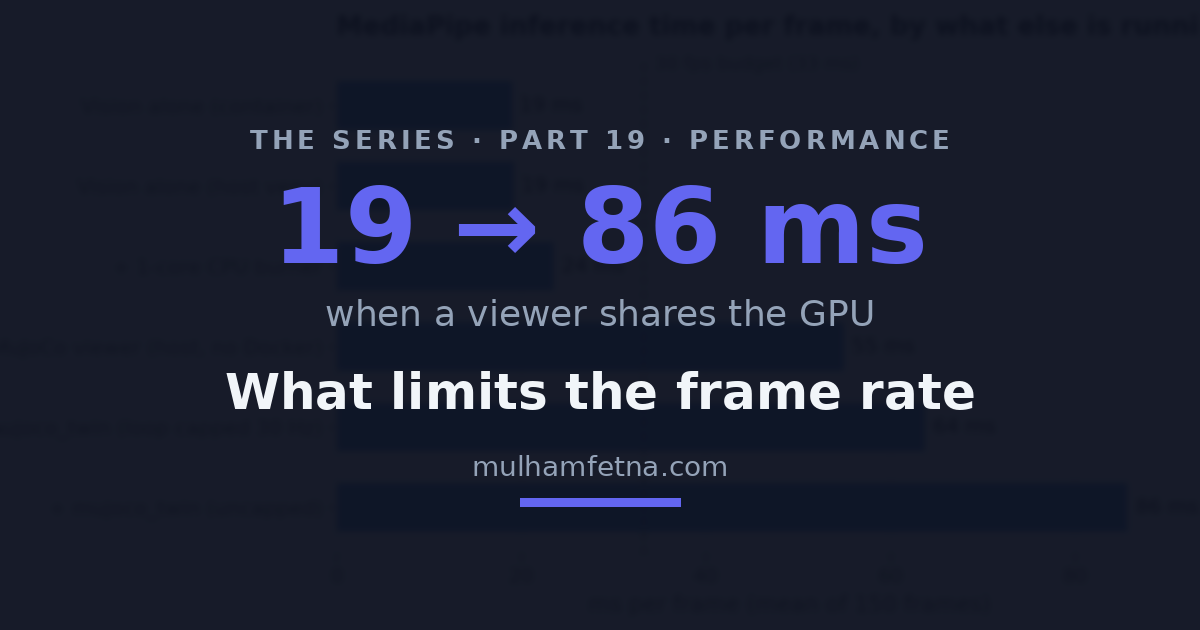

The single-script version felt smoother than the containers. The obvious suspect was Docker. The
measurements say otherwise — and point at something more interesting: two programs sharing one
integrated GPU.
Setup #
Laptop with an Intel Comet Lake CPU (12 threads) and Intel UHD Graphics; Linux on Wayland with XWayland; USB webcam at 640×480, 30 fps, YUYV. Each row: mean of 150 frames after a 10-frame warm-up, no hand in view. Measured 2026-09-16.
The result #
| Condition | Camera read | MediaPipe | imshow |
Loop |
|---|---|---|---|---|
| Vision alone, container | 10.0 ms | 19.0 ms | 4.5 ms | 29.8 Hz |
| Vision alone, host venv (MediaPipe 0.10.11) | 10.6 ms | 19.2 ms | 3.9 ms | 29.7 Hz |
| Container vision + 1-core CPU burner | 8.2 ms | 23.5 ms | 3.9 ms | 28.1 Hz |
| Host vision + plain MuJoCo viewer on host (no Docker, no ROS) | 1.6 ms | 54.9 ms | 5.9 ms | 16.0 Hz |
Container vision + mujoco_twin capped at 30 Hz |
1.7 ms | 63.7 ms | 8.1 ms | 13.6 Hz |
Container vision + mujoco_twin as shipped |
1.9 ms | 85.6 ms | 10.2 ms | 10.2 Hz |
End to end, ros2 topic hz /hand/target_flexions read 30.0 Hz with only vision_tracker running and
10.7 Hz once mujoco_twin started.
The camera-read time drops when the loop slows, because a frame is already waiting in the driver buffer.
What it rules out #
| Hypothesis | Test | Verdict |
|---|---|---|
| Docker overhead | same benchmark, container vs host venv | ✘ — 19.0 vs 19.2 ms |
| MediaPipe version (0.10.14 vs 0.10.11) | same comparison | ✘ |
| ROS 2 / DDS | a plain viewer with no ROS still slows MediaPipe | ✘ as the cause |
| General CPU load | busy loop on one core | ✘ — +4 ms |
| The twin’s unthrottled loop | cap it at 30 Hz | ✘ — still 64 ms |
| Any concurrently rendering MuJoCo viewer | all three viewer rows | ✔ 3–4.5× slower, every time |
The leading hypothesis: one iGPU, two OpenGL programs #
- MediaPipe’s own log shows it creating an EGL context on the Intel iGPU at startup — even for the CPU graph.
- The MuJoCo viewer renders on the same iGPU through GLFW and XWayland.
- CPU load alone doesn’t reproduce the slowdown; a concurrent viewer does, even at 30 Hz and without Docker.
- The standalone script runs both in one process and syncs the viewer only once per camera frame.
Not confirmed. The investigation stopped here because the pipeline worked well enough. Treat GPU
contention as the best current explanation, not a finding.
Next experiments, one variable at a time:
- Start the vision container without
/dev/dri(and withoutprivileged, which exposes it anyway) so MediaPipe can’t open its EGL context on the iGPU. Does the viewer still slow it? - Run
mujoco_twinheadless withMUJOCO_GL=egland no window. If MediaPipe recovers, rendering is the trigger. - Render MuJoCo on a different GPU — discrete or NVIDIA — and repeat.
- Instrument
standalone/main.pythe same way for a like-for-like single-process baseline.
Cheap wins regardless of the cause #
| Change | Expected effect |
|---|---|
Throttle viewer.sync() to ~60 Hz while physics keeps stepping at 500 Hz |
fewer render submissions on the shared GPU, less CPU |
Drop or decimate cv2.imshow in headless deployments |
saves 4–10 ms per frame |
| Capture at 320×240 | MediaPipe crops the hand anyway |
| Grab frames on a thread; process only the newest | bounded latency when inference is slower than the camera |
Reproduce it #
import time, cv2, mediapipe as mp
cap = cv2.VideoCapture(0)
hands = mp.solutions.hands.Hands(static_image_mode=False, max_num_hands=1,
                                 min_detection_confidence=0.5, min_tracking_confidence=0.5)
for _ in range(10): cap.read()                                   # warm-up
N = 150; tr = tp = ts = 0.0; t0 = time.perf_counter()
for i in range(N):
    a = time.perf_counter(); ok, f = cap.read(); b = time.perf_counter()
    hands.process(cv2.cvtColor(f, cv2.COLOR_BGR2RGB)); c = time.perf_counter()
    cv2.imshow("bench", f); cv2.waitKey(1); d = time.perf_counter()
    tr += b - a; tp += c - b; ts += d - c
T = time.perf_counter() - t0
print(f"loop {N/T:.1f} Hz | read {1000*tr/N:.1f} ms | mediapipe {1000*tp/N:.1f} ms | imshow {1000*ts/N:.1f} ms")
env -u PYTHONPATH venv/bin/python bench.py # host
docker compose run --rm --no-deps -v "$PWD":/bench:ro --entrypoint bash \
vision_tracker -c 'python3 /bench/bench.py' # container
docker compose up -d mujoco_twin # then repeat with the twin runningStop the full stack first — a camera opens in one process at a time.